Visiting Japan--The tail of two vacations in one PART--ONE
Planning your first trip to Japan? Discover what I wish I'd known about hotels, food, money, accessibility, luggage, costs and getting around. Part One
REVIEWS BY DESTINATION
singlesickbroketraveler.com
1/26/202613 min read


Japan—The tale of two vacations in one Part 1
My First Trip to Japan: What I Wish I'd Known Before I Went
Japan wasn't on my short list of places I wanted to visit.
Don't get me wrong. I knew Japan would be interesting. But between the cost, the language barrier and simply being so far from home, I thought it would probably be one of those places I visited someday.
Boy, was I wrong.
Japan turned out to be one of the greatest travel experiences of my life.
And the funny thing is, I probably wouldn't have gone when I did if it weren't for Star Wars.
Star Wars Sent Me to Japan
I'm a Star Wars fanatic. I've been one since I saw the original movie on the big screen when I was four years old in 1977.
In 2017, I traveled to my first Star Wars Celebration in Orlando. After that, I was hooked. So when I learned that Star Wars Celebration was heading to Tokyo, there really wasn't much of a debate.
I was going to Japan.
But I didn't want to fly all the way across the world, attend a convention and fly home. That's not how I travel. If I'm going somewhere, I want to experience the place. I want to see how people live, eat the food, learn something about the culture and stay long enough that I come home feeling as though I actually went somewhere.
So what started as a trip to Star Wars Celebration became a 20-day Japanese adventure.
And that's where my first lesson about Japan begins.
Give Japan More Than a Few Days If You Can
I know everyone doesn't have three weeks of vacation time or the budget for a 20-day international trip. You don't have to travel the way I did.
But Japan taught me how much more there can be to a destination than the one thing that brought you there.
The convention brought me to Japan. Japan itself made me want to explore.
My friends Cheri and Sean were coming, along with their daughter Mikayla and her fiancé—now husband—Josh. Mikayla had studied in Japan and spoke fluent Japanese, which certainly didn't hurt.
The five of us had about ten months to plan.
And with five people living in two different states, we needed a plan.
Planning a Big Trip With Other People
We set up Zoom meetings and divided responsibilities.
This is one of those things that sounds overly organized until you're the person trying to coordinate hotels, activities, transportation, reservations and money for five adults.
We made a list of everything that had to be done and assigned jobs.
If somebody was responsible for an activity, that person researched it, made the reservation when necessary and reported back to everyone else. For example, we all wanted to see a sumo wrestling experience. One person took responsibility for researching it and arranging it for the group.
Everybody had a job.
That kept one person from becoming the unpaid travel agent for everybody else.
SSBT TIP: If you're traveling with friends or family, divide the planning before the trip. Decide who's researching transportation, accommodations, activities and reservations. It makes planning easier—and can prevent resentment before the vacation even begins.
We also got professional help.
My longtime travel agent, Lynne, had been to Japan and wanted us to have the best experience possible. She connected us with Eri, a Japan travel specialist and native of Japan who regularly returned to visit family.
Cheri and I met with Eri several times. We told her what we wanted to experience, where we wanted to go and what kind of trip we envisioned.
She put together an itinerary.
There was only one problem.
It cost more than some of us wanted to spend.
So we compromised.
We planned the first portion ourselves and used Eri's itinerary for another portion of the trip.
That decision taught me something I still believe about budget travel:
You don't always have to choose between doing everything yourself and paying someone to do everything for you.
Sometimes the smartest budget is a combination of the two.
Check out Budget Travel section of my blog for more information and tips on traveling on a tight budget.
Where We Stayed in Tokyo
We stayed in two different areas because the trip had two very different purposes.
For our Tokyo sightseeing, we stayed at the Royal Park Hotel. Later, when it was time for Star Wars Celebration, we moved to Chiba so we'd be closer to the convention.
That was another decision I'd make again.
A hotel shouldn't just fit your budget. It should fit what you're actually doing.
Royal Park Hotel
The Royal Park Hotel worked wonderfully for the sightseeing portion of our trip.
We took a shuttle from Narita Airport to the hotel, and once we were settled, we had easy access to restaurants, convenience stores, transportation and other things we needed.
One of my favorite things about the location was how easy it made getting around. When you're in an unfamiliar country, there's something reassuring about knowing you can explore all day and still figure out how to get back to your hotel.
The rooms were comfortable, the hotel was clean, the staff was attentive, and we had a breakfast buffet with both Western and Japanese options.
But here's something I'd tell today's traveler: don't choose a hotel simply because I liked it or because somebody on the internet gave it five stars.
Look at the location in relation to your plans.
If walking long distances is difficult, if your energy is unpredictable or if you know you're going to need rest during the day, saving $20 on a hotel that adds another 30 or 40 minutes of transportation may not actually save you anything.
Sometimes location is an accessibility feature.
Check out my article, How to Plan a Trip When Your Energy Is Unpredictable. You'll received a free A, B and C Vacation Planner to help you plan you vacation to your needs.
Staying in Chiba for Star Wars Celebration
When convention time arrived, we moved to Hotel Sunroute Chiba.
The room was noticeably smaller than the one at the Royal Park Hotel, but that wasn't the most important thing anymore. We wanted to be near the convention.
The hotel was connected to JR Chiba Station and surrounded by restaurants, shops and other conveniences.
And this hotel gave me one of my favorite unexpected travel memories.
I met another Star Wars fan from Australia in the elevator.
That's it. That's how it started.
We started talking, discovered our mutual Star Wars obsession and ended up going to the convention together and taking pictures.
Travel does that.
Sometimes the person you remember from a trip isn't someone you planned to meet at all.
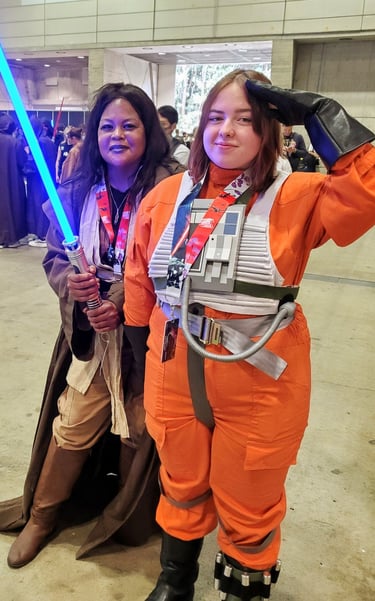
Me with the Star Wars fan from Australia I met in the hotel elevator
Sumo Wrestling: One of Those “We're Really in Japan” Moments
One of the experiences we specifically wanted was sumo wrestling.
And I'm so glad we did it.
There are certain moments on a trip when you stop thinking about transportation, hotel reservations, money and schedules and suddenly realize:
I'm in Japan.
This was one of those moments.
We watched the sumo wrestlers, enjoyed the entertainment and took a group photograph afterward.
Our group with the Sumo wrestlers and Geisha performer
It's easy to spend an international vacation racing from landmark to landmark because you want to say you saw everything.
But some of my strongest memories aren't necessarily of famous landmarks.
They're experiences.
That's why I always recommend leaving room in your itinerary for something that lets you participate in the culture instead of only looking at it.
One of the Best Things We Did: Send Our Luggage Ahead
If there's one Japan travel tip I wish every traveler knew before arriving, it's this:
You do not necessarily have to drag your suitcase everywhere you go.
Japan has luggage delivery services that can transport bags between airports, hotels and other destinations.
We used the service between hotels.
At the hotel, we asked what time our luggage needed to be dropped off, completed the paperwork and left the bags to be transported to our next destination.
It was amazing.
And I had luggage.
Remember, I was going to Star Wars Celebration. I had an entire Jedi costume, robes and all. I had my carry-on, a large personal bag and a big checked suitcase.
I even had a toy lightsaber.
The luggage service handled it.
Today Japan still has an extensive luggage delivery system—often called takuhaibin or promoted to international visitors as Hands-Free Travel. Depending on the location and service, luggage can be sent from airports to hotels, between hotels and from certain convenience stores.
If you have chronic pain, fatigue, mobility limitations or simply don't want to wrestle a 40-pound suitcase through a busy train station, look into this before your trip.
Convenience is wonderful.
Saving your energy can be even more valuable.
Click on the section Traveling With Chronic Illness to learn more ways to make travel fit you chronic illness.
Money in Japan: My Experience vs. What You'll Find Today
When I traveled to Japan, I treated it primarily as a cash-based destination.
I brought cash, exchanged money and used ATMs at 7-Eleven convenience stores when I needed more.
That worked very well for me at the time.
Japan has become considerably more cashless since my trip. Credit cards, electronic payments and contactless payment methods are now much more common, particularly in cities, hotels, major stores and restaurants.
But don't take that to mean you should arrive with no yen.
Smaller businesses and places outside major tourist areas may still require cash.
So my updated advice is simple:
Don't rely entirely on cash, and don't rely entirely on cards.
Have access to both.
Also pay attention when an ATM or payment terminal asks whether you'd like the transaction converted into your home currency. Understand the exchange rate and fees before agreeing to anything.
And before leaving home, check your own bank's international ATM and foreign-transaction fees. A bunch of “little” fees can quietly become a travel expense of their own.
Getting Online Is Easier Now
This is another area where travel has changed since my trip.
I didn't want to pay my carrier's international daily charge, so I rented a portable Wi-Fi router at the airport.
The router worked.
Returning it became an adventure.
I forgot to return the thing before leaving Japan.
Then came emails, shipping it back internationally and extra expense. By the time I was finished, avoiding my phone carrier's international charges wasn't quite the bargain I'd envisioned.
Today travelers have more choices. Depending on your phone and carrier, an eSIM may be the easiest solution. Physical SIM cards and pocket Wi-Fi devices are also widely available.
My advice?
Figure this out before you leave home.
Know whether your phone is unlocked, whether it supports an eSIM, what your carrier charges internationally and how much data you realistically use.
And if you rent something that has to be returned?
Put a reminder in your phone.
Learn from me.
There are so the Single, Sick and Broke Traveler has to offer! Free workbooks, checklists and so much more. Click on the button below to join the Single, Sick and Broke Traveler community!
Japan Surprised Me With Its Accessibility
This was one of the biggest surprises of the entire trip.
I expected Japan to be challenging physically.
Instead, I found elevators and escalators throughout many of the transportation systems we used. Subway platforms often had seating. Many places we visited were easier for me to navigate than I expected, and I noticed tactile paving designed to help travelers with visual impairments.
That doesn't mean every station, attraction or historic site will work for every disability or mobility need. Accessibility varies, and anyone who needs a specific accommodation should research the actual stations, hotels and attractions on their itinerary.
But don't automatically cross Japan off your list because you assume it will be impossible.
Japan has continued expanding accessible transportation and tourism infrastructure, including elevators, ramps and accessibility accommodations at many major stations and public facilities.
And here's something I understand even better now than I did then:
Accessible travel isn't only about whether someone uses a wheelchair.
It's also about how far you have to walk, whether you can sit down, whether there are stairs, whether you can send your luggage ahead and how much energy getting from Point A to Point B will cost you.
Those details matter.
I Can Walk—So I Never Thought Airport Assistance Was for Me is an article to help you navigate airports when your body or mind is not cooperating.
Let's Talk About the Food
Oh, the food.
Japanese food is not all sushi.
Not even close.
I ate udon noodles, Wagyu beef, enormous pot stickers, incredibly fresh fruits and vegetables and all kinds of things I hadn't expected before I arrived.
One of the experiences I loved was having Wagyu presented before it was cooked in front of us.
Wagyu before it was cooked
And then there were the pot stickers.
The giant Japanese pot stickers with my hand for scale
Yes, I needed photographic evidence.
Food can become one of the best parts of experiencing a destination, but what and how you eat can also affect how you feel while you're traveling. If you're trying to enjoy the local food without spending the rest of your vacation regretting it, read When You Eat Well, You Travel Well.
One thing that fascinated me was how closely restaurant food often resembled the displays or photographs advertising it. Japan is famous for incredibly realistic food replicas displayed outside restaurants so customers can see what dishes look like before ordering.
That can be particularly helpful when you're somewhere you don't speak the language.
You can look.
You can point.
You can eat.
And sometimes that's all the communication you need.
And if the thought of traveling somewhere you don't speak the language makes you nervous, read Communicate When You Don't Speak the Language. You don't have to speak fluently to find your way, order a meal or connect with people.
Is Japan Expensive?
Before I went, Japan had a reputation in my mind as an extremely expensive destination.
Then we went out for udon noodles our first night.
The chef prepared the noodles right in front of us. We had food, drinks and appetizers, and when the bill arrived, we were shocked—in a good way.
Japan certainly can be expensive. Luxury hotels, high-end dining and certain experiences can cost plenty.
But that doesn't mean every meal, hotel or experience has to be expensive.
Convenience stores, casual restaurants, public transportation and thoughtful hotel choices can make a huge difference.
That's another reason I don't like simply labeling a destination “cheap” or “expensive.”
The better question is:
Can I make this destination fit my budget?
That's a very different question.
That's why reading, Attention Spoonies: How to Travel Even If You're Broke—The Complete Guide to Seeing the World on a Tiny Budget will help you plan your vacations according to your budget needs.
What Should You Wear?
I found everyday dress in Japan somewhat more conservative than what many Americans might wear casually at home, although you'll certainly see every kind of fashion imaginable—especially in major cities.
You don't need to completely change who you are.
But comfortable shoes matter.
A lot.
Many travelers do considerable walking in Japan, and some temples, traditional accommodations and restaurants may require you to remove your shoes.
I learned the shoe lesson the hard way.
I brought a pair that I'd worn all over Europe and assumed they would be fine.
They weren't.
I wore the soles down and didn't realize it until my feet started hurting. Finding replacement shoes in my size wasn't easy.
So now I would add another rule:
Never take your shoes' comfort for granted just because they were comfortable on another trip. Check them before you pack them.
Your feet will be doing a lot of the work.
What I Wish I'd Known Before My First Trip to Japan
Looking back, there are a few things I would tell anyone planning a first visit.
Don't let the language barrier scare you away. In major tourist areas, you'll often encounter English signage, and translation technology makes communication even easier today.
Don't assume Japan has to be prohibitively expensive.
Don't drag all your luggage through every train station if forwarding it makes more sense.
Don't assume accessibility means only wheelchair accessibility.
Don't plan every minute.
Don't spend so much time checking attractions off a list that you forget to experience where you are.
And don't decide a destination isn't for you before you've really looked at it.
I almost did that with Japan.
Japan Wasn't on My List. Then It Became One of My Greatest Trips
I went because of Star Wars.
That's the truth.
Star Wars Celebration gave me the reason to buy the ticket.
But somewhere between the Sumo wrestlers, train stations, enormous pot stickers, new friends, luggage magically arriving at another hotel and simply experiencing a culture completely different from my own, Japan became much more than the place where a convention happened.
It became one of those trips that reminded me why I travel.
Sometimes the destination you weren't sure about becomes the one you can't stop talking about.
And sometimes the trip you think you're taking isn't the trip you end up having.
That's part of the beauty of it.
Ready to Make Travel Fit Your Life?
You don't need unlimited money, unlimited energy or somebody else's idea of the perfect vacation.
You need a trip that works for you.
If you're trying to figure out how to travel solo, travel with chronic illness, stretch a limited budget or simply get the confidence to go somewhere you've been dreaming about, Join the Tribe.
We'll figure out how to get there your way.
Travel information changes. Always verify current transportation, accessibility, payment, connectivity and entry information before your trip.
Japan: The Tale of Two Vacations in One--Part Two will give you a more in-depth look at all the activities I saw and what I did in Tokyo, Hakone, Osaka and Kyoto is coming soon.


The Single, Sick & Broke Traveler
Travel stories for the brave and budget-conscious.
Contact Me!
© 2025. All rights reserved.