Want to eat well? Travel!
Discover how to enjoy local food without overspending, from hotel breakfasts and local shops to food tours, picnics, and the perfect splurge.
THE LITTLE THINGS
singlesickbroketraveler.com
12/14/202514 min read


Want to Eat Well? Travel!
Eat Well, Spend Less: How to Enjoy Local Food When You Travel
One of my favorite parts of traveling is eating.
Not just eating because I’m hungry, either. Food is part of how I experience a destination. It’s one of the ways I learn about the people, the culture, and sometimes even the history of a place.
I’ve eaten Irish stew in Dublin that ruined other Irish stew for me. I’ve had French onion soup in Paris that made me understand why people make such a fuss about French onion soup. I’ve been sent to a little restaurant by a hotel clerk and ended up having a meal I still remember years later. I’ve asked a local where to get clam chowder and found myself sitting in my car eating some of the best chowder I’ve ever had.
And then there was Japan. Japan introduced me to Wagyu.
We’ll get to the Wagyu.
The problem is that food can also become one of the biggest expenses of a trip—especially if you automatically assume that traveling means eating breakfast, lunch, and dinner in restaurants every day.
It doesn’t.
You can eat incredibly well, experience authentic local food, and still keep your food budget under control. Sometimes that means having breakfast at your hotel. Sometimes it’s walking into a convenience store in Japan or a little neighborhood shop you’ve passed three times. Sometimes it’s buying lunch and having a picnic.
And sometimes it means saving money on all of those meals because there is one thing you absolutely intend to eat before leaving the country.
Like Wagyu.
Research Food Prices Before You Leave Home
One thing I’ve learned to do is look up approximately what food costs where I’m going before I ever leave home.
I’m not trying to figure it out penny for penny. That would make me crazy, and it probably wouldn’t be accurate anyway. Prices change, exchange rates change, and travel rarely goes exactly according to plan.
I’m trying to establish a range.
What does an inexpensive meal generally cost? What might I pay at a casual restaurant? How expensive are convenience stores, bakeries, markets, or little neighborhood shops? What about a nicer dinner? If there’s a food tour, cooking class, or particular restaurant I’m interested in, what does that cost?
Once I know those things, I can make a much more realistic food budget.
And then I add a cushion.
Maybe the restaurant I planned on is closed. Maybe I’m exhausted and the least expensive place is six blocks away, while there’s another perfectly good restaurant right downstairs. Maybe I discover something I didn’t even know existed and decide I want to try it.
I don’t want my budget so tight that an unexpected bowl of something delicious creates a financial crisis.
A food budget should give you guidance—not hold you hostage.
Read, Attention Spoonies: How to Travel Even If You're Broke: The Complete Guide to Seeing the World on a Tiny Budget You can have chronic illnesses and still see the world!
Budget According to How You Actually Eat
Here’s something else we don’t talk about enough when we’re planning a travel budget:
How do you normally eat?
I tend to eat breakfast, maybe a little lunch—or sometimes no real lunch at all—and then dinner.
So why would I budget for three full restaurant meals every single day?
Someone else may be completely different. Maybe you don’t care about breakfast but absolutely need lunch. Maybe you eat several smaller meals throughout the day. Maybe dinner isn’t particularly important to you.
Your travel food budget should reflect your eating habits, not some imaginary traveler who eats three restaurant meals a day.
This becomes especially important when you’re traveling on a limited budget. If you know where you naturally eat less, that’s one of the easiest places to save money without feeling deprived.
Don’t Overlook the Hotel Breakfast
When I’m traveling internationally, hotel breakfast can be much more than a plate of familiar breakfast food.
It can be my first food experience of the day.
Depending on the hotel, breakfast may be included in the room rate or available as an option when you book. That’s something worth comparing when you’re choosing accommodations because an included breakfast can change your daily food budget considerably.
And you’re in another country.
That breakfast may include foods that people actually eat there. Yes, there may also be familiar choices for international visitors, including an American-style breakfast in some places. But I’ve found that hotel breakfasts can give me the opportunity to try local foods without having to find a restaurant first thing in the morning.
For someone who eats the way I do, a substantial breakfast can carry me for quite a while.
If the hotel’s rules allow it, there may also be an appropriate item you can take with you or back to your room for later. I’m not suggesting stuffing your purse with half the breakfast buffet. Please don’t tell the hotel that the Single, Sick & Broke Traveler told you to steal six croissants.
But if the hotel allows guests to take a piece of fruit, packaged item, or something similar, that may become a snack later.
The important thing is to find out what is included, understand the hotel’s policy, and use what you’re already paying for.
You Don’t Have to Eat in Restaurants to Eat Local Food
This was something Japan really drove home for me.
Convenience-store food there isn’t necessarily what an American traveler may picture when they hear “convenience-store food.” Japanese convenience stores—often called konbini—can offer a wide variety of prepared foods and snacks.
You can walk into a 7-Eleven or another convenience store, buy something inexpensive, and have a perfectly good meal without sitting down in a restaurant.
And it’s not just Japan.
When I’m traveling, I pay attention to little shops, bakeries, markets, grocery stores, delis, and other places along the streets.
Go inside.
Look around.
Even if you don’t buy anything, it’s interesting to see what people actually eat. What snacks are on the shelves? What flavors are popular? What does the bakery sell? What prepared foods are people picking up on their way home?
That’s part of experiencing another country.
And if you do buy something, you may have just solved lunch for a fraction of what you would have spent at a restaurant.
Take it back to your hotel. Eat in the lobby if that’s permitted. Find somewhere appropriate to sit outside. Turn it into a picnic.
You’re not missing the local food experience.
You are having the local food experience.
You’re just experiencing a different part of it.
Have a Picnic
I think travelers sometimes make food more complicated than it needs to be.
Go to a market, bakery, grocery store, or little shop. Buy a few things that look good. Find a park, waterfront, garden, bench, or another place where eating is permitted.
There’s lunch.
And you’re sitting there watching the destination happen around you.
You don’t need an elaborate picnic basket. You don’t need matching napkins. You don’t need to arrange everything beautifully so you can photograph it.
A sandwich, something interesting from the local market, and a drink are perfectly capable of becoming a picnic.
We’re traveling. We’re not auditioning.
For a budget traveler, you’ve saved money.
For a solo traveler, it can be an easy, low-pressure meal.
And for someone with limited energy, it can sometimes be far easier than finding a restaurant, waiting for a table, sitting through a meal, and getting back to the hotel afterward.
Save on the Ordinary Meals So You Can Splurge on the Extraordinary Ones
This is where my philosophy gets really simple.
I don’t need every meal to be special.
I’d rather save money on breakfast or lunch and spend it on something I really want.
Maybe breakfast is already included at my hotel. Maybe lunch comes from a little neighborhood shop. Maybe I have a picnic.
Then dinner can be the meal I’ve been waiting for.
Which brings us back to Japan.
And the Wagyu.
Wagyu: The Splurge I Apparently Couldn’t Stop Splurging On
I had the extreme pleasure of eating Wagyu beef in Japan.
Then I wanted it again.
And again.
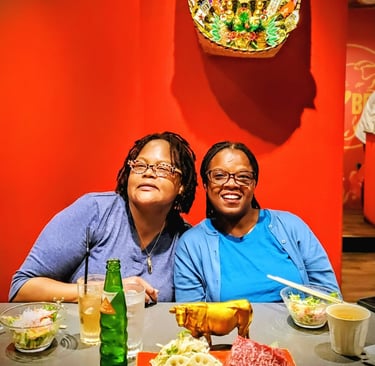
Eventually I suggested Wagyu to my friend Cheri one more time. She looked at me and exclaimed:
“We’ve had Wagyu for the last three days!”
My response was basically, “Well, as long as I get some before we leave Japan.”
And yes, I got Wagyu that night anyway.
It became a running joke.
Actually, let me correct that.
It still is a running joke, and I’m pretty sure it always will be.
Apparently, once you spend several days repeatedly suggesting Wagyu for dinner, your friends never let you forget it.
But hidden inside my Wagyu obsession is something I genuinely believe about traveling on a budget.
Choose your splurge.
I could eat inexpensively during other parts of the day and spend my money on the thing I really wanted.
Budget travel shouldn’t mean that you never get to have the thing you’ve been dreaming about. The whole reason I’m careful with money in some areas is so I can spend it where it matters to me.
And in Japan, apparently, it mattered to me repeatedly.
Want to Make Travel Fit Your Life—and Your Budget?
Join the Tribe for practical travel tips, real-life stories, checklists, and strategies for traveling solo, with chronic illness, and without spending a fortune.
Take a Food Tour Early in Your Trip
I’ve taken food tours in Japan, including walking tours in Kyoto and Osaka, and I think they’re a wonderful way to learn about a destination.
The Osaka tour was particularly fun because our guide was enthusiastic and knowledgeable, and that energy spread through the group.
We weren’t simply eating.
We were learning.
On one tour, we followed a route similar to what local businesspeople might do after work, moving from place to place while trying different foods and drinks. Having someone explain what we were eating and why it was significant gave the experience a completely different dimension.
If you’re going to take a food tour, I like the idea of doing it fairly early in the trip.
You may discover a food you want to eat again, a neighborhood you want to revisit, or a little restaurant you never would have found on your own.
Is a Food Tour Worth the Money?
That depends.
Before I book one, I want to know what’s actually included. How many stops are there? How much food will we get? Is it enough to replace a meal or are these small tastes? How long is the tour? Are drinks included?
And because this is the Single, Sick & Broke Traveler, I want us to ask some additional questions.
How far are you walking?
Are there places to sit?
Are there stairs?
What happens if you need a bathroom?
Can dietary restrictions be accommodated?
What’s the cancellation policy if your body decides that today is not the day?
The cheapest food tour isn’t necessarily the least expensive choice if you pay for something your body can’t comfortably finish.
How to Plan a Trip When Your Energy Is Unpredictable is a great article to plan your vacation according to your energy levels. It includes an A, B and C Vacation Planner so you can have a great vacation!
A Cooking Class Is Still on My Travel List
There is one food experience I haven’t done yet that I absolutely want to do: take a cooking class while I’m traveling.
It’s one of my plans.
I love the idea of going beyond simply ordering a local dish and actually learning how it’s made. You get to learn about the ingredients, the techniques, and perhaps some of the history or traditions behind what you’re cooking.
And then you bring something home that doesn’t take up any room in your suitcase.
You bring home the ability to recreate part of the trip.
Someday I want to be standing in a kitchen somewhere far from home, learning how to make something I probably would never have attempted on my own. And when I finally do it, I have a feeling it will become another one of those travel memories I talk about for years.
But just like a food tour or special restaurant, a cooking class is something I would plan and budget for.
You don’t have to do a food tour, cooking class, fancy restaurant, and every other food experience available.
Pick what matters to you.
Your travel budget doesn’t have to fund somebody else’s bucket list.
Ask the Locals Where They Eat
This is one of my favorite travel strategies because it has given me some fantastic meals.
Years ago, I was working in New Hampshire and wanted clam chowder. I’d heard about New England clam chowder, and I wasn’t leaving without trying some.
I asked a local woman at a gas station where I should go.
She directed me to a local bar and told me they had “pretty good” clam chowder.
I walked into this dark, nearly empty little bar wondering what I’d gotten myself into.
Then I ordered the chowder.
It came in a bread bowl.
I got it wrapped up, drove a few miles, pulled over, and ate it.
That bread bowl must have been freshly baked because it was warm and incredibly soft. I tore pieces off and dipped them into the chowder.
It was the best clam chowder I’d ever had.
And I remember thinking:
If she thought that was only “pretty good,” what did she consider excellent?
A Hotel Clerk Sent Me to One of My Favorite Meals in Paris
Paris taught me the same lesson.
I asked the clerk at my hotel where I should eat.
She sent me to a little restaurant tucked away on a side street. It couldn’t have had more than about ten tables. There was a fire going, and the place felt more like someone’s home than a tourist restaurant.
I ordered beef bourguignon.
I still remember that meal.
That’s why I don’t always ask, “What’s the best restaurant?”
Sometimes I ask:
“Where would you eat?”
Those aren’t necessarily the same question.
Dublin Ruined Irish Stew for Me
When I was in Dublin near the Temple Bar area, I went into The Shack and ordered Irish stew.
I was amazed.
I was also getting full and couldn’t finish it, which genuinely bothered me because I wanted every bite.
And the bread served with it?
Wonderful.
Eventually I came home and bought Irish stew from Costco.
That was a mistake.
There was probably nothing wrong with the Costco stew. Unfortunately, my brain immediately compared it with the stew I’d eaten in Dublin.
The Costco stew lost.
I gave it to friends.
Sometimes you eat something in the place where it belongs and discover that you’ve accidentally ruined the ordinary version for yourself.
Then Paris Ruined French Onion Soup
Before visiting Paris, I wasn’t particularly excited about French onion soup.
Then I ordered quiche that came with French onion soup.
Oh. So that’s what everybody has been talking about.
The soup was rich and flavorful, and suddenly I understood why people love it.
The quiche was wonderful too, but I still remember being surprised by that soup.
That’s one of my favorite things about eating when I travel. Sometimes you’re not searching for a life-changing food experience.
It just happens.
Sometimes Eating in Your Hotel Room Is Exactly What You Need
There’s another side to all of this, particularly for those of us traveling with chronic illness.
Some evenings, I don’t have the energy for the restaurant experience.
I’m done.
I don’t want to research another restaurant. I don’t want to get dressed to go back out. I don’t want to travel across town, wait for a table, order dinner, sit there, and then figure out how to get back to my hotel.
I want something to eat, and I want my bed.
That’s where the convenience store, grocery store, bakery, market, or little shop you noticed earlier can become more than a budget strategy.
It can become an energy strategy.
If an inexpensive meal in my hotel room gives my body the rest it needs so I can enjoy tomorrow, I haven’t wasted an evening of my vacation.
I’ve protected tomorrow.
Check out my article, How to Plan a Vacation and Actually Relax When You Have a Chronic Illness. You'll learn how to be rested when you get home without needing a vacation from your vacation.
Travelers with medical conditions or weakened immune systems may also need to think differently about food safety. What is safe for one traveler isn’t automatically the right choice for another, particularly with raw or undercooked foods, unpasteurized products, food that hasn’t been stored at a safe temperature, or destinations where food and water sanitation may be a concern.
Know your body. Know your medical situation. And when necessary, talk with your healthcare provider before traveling.
Medical disclaimer: This article shares my personal experiences and general travel information. It is not medical advice. Talk with your healthcare provider about your individual health needs and food-safety considerations when traveling.
Eat Well Doesn’t Have to Mean Eat Expensive
That’s probably the biggest thing I’ve learned.
I can eat breakfast at my hotel and try something local.
I can walk into a convenience store in Japan.
I can buy something from a bakery.
I can explore a neighborhood grocery store.
I can have a picnic.
I can ask somebody who lives there where they eat.
I can spend money on a food tour because I want the experience and education that comes with it.
Someday, I can take that cooking class I’ve been wanting to take.
And I can save money on several meals because tonight I want the Wagyu.
Again.
Eating on a budget doesn’t have to mean missing the food of a destination.
Sometimes the inexpensive food is the food of the destination.
Food Becomes Part of Your Travel Story
Years later, I may not remember every museum room I walked through or every building I saw.
But I remember that Irish stew.
I remember the French onion soup.
I remember the little restaurant in Paris.
I remember sitting in my car eating clam chowder from a warm bread bowl.
And Lord knows I remember the Wagyu.
So eat the food.
Walk into the little shop.
Try something you don’t recognize.
Ask the local.
Take the food tour if you can afford it.
Have the picnic.
Eat dinner in your hotel room when your body says it’s had enough.
Research the prices before you leave, give yourself a cushion, and spend your food money on the experiences that matter to you.
You don’t have to eat like anybody else when you travel.
Just like everything else about travel:
Get there your way.
Travel doesn’t have to look like anyone else’s to count.
If you’re traveling solo, managing chronic illness, stretching a limited budget—or doing all three at once—join the Single, Sick & Broke Traveler community for real-world travel advice, practical checklists, personal stories, and ways to make travel fit your actual life. Click on button below.

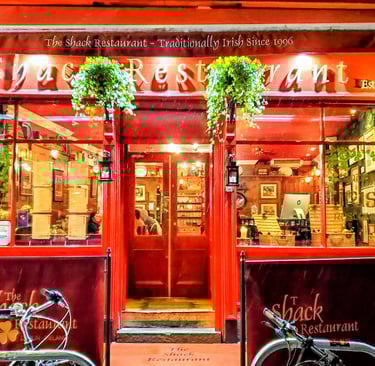


The Shack Restaurant Dublin, Ireland
Best French Onion soup in Paris
Irish stew from The Shack Restaurant
Quiche pairs perfectly with French Onion soup in Paris


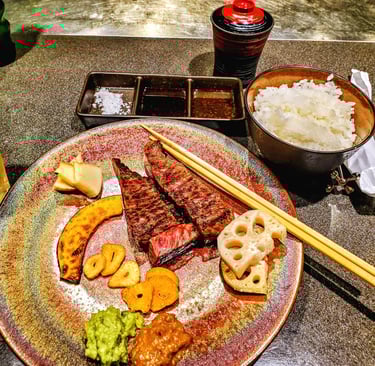
Wonderful Wagyu in Tokyo
My friend, Cheri, and me eating Wagyu in Tokyo


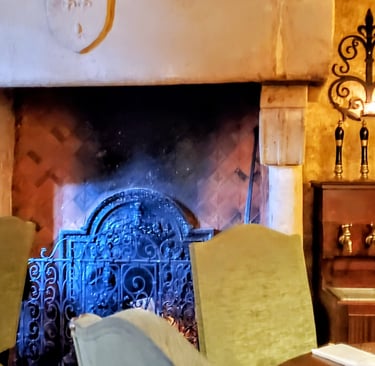
Quaint and cozy restaurant in Paris
Best Beef Burgundy ever!


The Single, Sick & Broke Traveler
Travel stories for the brave and budget-conscious.
Contact Me!
© 2025. All rights reserved.