When the caregiver needs care too: Chronically ill caregivers and their ill loved one can strengthen their bond through travel
So many of us are caregivers. But no one talks about caregivers who are chronically ill themselves. If you are a chronically ill caregiver, you CAN travel with your ill loved one. This post discusses the importance of travel and how it will strengthen your bond.
FOR CAREGIVERS
singlesickbroketraveler.com
4/24/20269 min read


When the Caregiver Needs Care Too: Traveling When You're Both Chronically Ill
Did you know millions of Americans provide care for a family member or loved one? That's a lot of people. But there's another part of caregiving that doesn't get talked about nearly enough:
Sometimes the caregiver needs care too.
Many caregivers are managing chronic illnesses, disabilities, pain, fatigue, medications, or their own physical limitations while caring for someone else. Caregiving is already a full-time emotional, physical, and mental commitment. Add chronic illness into the mix, and suddenly you're not just supporting someone else's needs—you're trying to manage your own body, your own limits, and your own health at the same time.
I know because I've lived it.
And while taking a vacation when both you and the person you care for have health issues may sound like absolute lunacy, I learned something important:
Travel can give you an opportunity to stop being only caregiver and patient for a little while and start being two people experiencing life together again.
Caring for Someone Else While Your Body Is Struggling Too
My mother had rheumatoid arthritis, and it ravaged her body. The biologic medications available today weren't widely available when she first became ill. She eventually participated in a study involving biologics, but by then she had already lived with the disease for years.
I had been her caregiver since I was 16 years old.
Then, in my mid-30s, I was diagnosed with rheumatoid arthritis and fibromyalgia myself.
My world turned upside down.
Suddenly, I had to change the way I provided care. One of the hardest parts was being tired and achy while still trying to take care of my mother. At the same time, I was trying to understand and accept what was happening to my own body.
My mother understood in a way few people could because she had lived with the same illnesses. She counseled me while I was caring for her.
We became even more of a team.
We had traveled before my diagnosis, and neither of us wanted illness to take that part of our lives away.
So we made a decision:
We would travel despite both of our illnesses.
If caregiving itself sometimes feels like a journey you never expected to take, read Traveling as a Caregiver: The Trip You Didn't Pack For. It's about the unexpected emotional, physical, and practical journey that comes with becoming responsible for someone you love.
The Reality No One Talks About
Caregiving at home can become routine in a way that slowly drains both of you.
Doctor appointments. Medication schedules. The same walls. The same worries. The same responsibilities.
Eventually, you can fall into roles.
You become "the caregiver."
They become "the person who needs care."
And somewhere underneath those responsibilities are two people who still want to laugh, see something beautiful, eat something delicious, and have something to talk about besides medications and doctor appointments.
Travel doesn't magically erase illness or responsibility. It doesn't mean you stop being a caregiver. And it certainly doesn't guarantee that everybody's body is going to cooperate.
What it can do is change the environment around you.
Sometimes that shift matters more than we realize.
Why Travel Can Strengthen Your Bond
When you step into a new place—whether it's a quiet beach town, a small road-trip stop, a national park, or even a nearby city—you're no longer just managing survival.
You're sharing an experience.
You laugh together. You notice things together. You solve little problems together. You make memories together.
For a little while, you get to be people again, not just roles.
And the moments don't have to be spectacular.
They might be:
- Watching a sunset somewhere new
- Trying a great meal together
- Sitting quietly without worrying about what's next
- Laughing because something didn't go remotely according to plan
- Seeing something you've both talked about seeing for years
Those little moments can feel enormous when so much of everyday life revolves around illness and caregiving.
When Both of You Need Care
Traveling when you're a caregiver with a chronic illness creates an unusual dynamic.
Both of you need care, just in different ways.
At home, that can sometimes feel overwhelming. While traveling, however, it can become something different: teamwork.
You begin to communicate honestly about what each person needs.
You pace yourselves together.
You become more patient with each other's limitations.
You learn when it's time to stop.
And hopefully, you begin supporting each other in ways that feel less one-sided.
It becomes less about who is stronger and more about how you're going to move through the experience together.
That's why planning for your own limitations matters just as much as planning for the person you're caring for. If your energy can change without warning, How to Plan a Trip When Your Energy Is Unpredictable can help you build a trip that has room for those changes instead of treating them like failures.
Don't Expect Your Loved One to Know How You're Feeling
When you're the caregiver, you're used to asking the questions.
How are you feeling? Do you need to rest? Are you in pain? Do you need your medication? Is this too much?
But when you're also chronically ill, those questions need to go both ways.
Your loved one may understand that you have an illness. They may know that you're tired or that you're hurting. But they can't always know what you're experiencing unless you tell them.
That's something I had to learn with my mother.
I couldn't assume that because she had rheumatoid arthritis too, she automatically knew how I was feeling at every moment. I had to communicate with her. If I was exhausted, hurting, overwhelmed, or simply needed to stop for a while, I needed to say so.
And something interesting can happen when you do that.
You give the other person permission to be honest too.
Instead of the caregiver constantly checking on the person receiving care, the conversation becomes:
How are you doing?
Here's how I'm doing.
What do you need?
Here's what I need.
Okay. How do we make today work for both of us?
That kind of communication can bring you closer because you're no longer trying to protect each other by pretending everything is fine. You're working together.
Maybe your loved one needs to go back to the hotel and lie down.
Maybe you're the one who needs the nap.
Maybe you're both exhausted and room service suddenly sounds like the greatest vacation activity ever invented.
That's okay.
Neither person's needs are more legitimate simply because one person is called the caregiver.
When you're traveling together and both of you are dealing with illness, care can go both ways. Talking honestly about what you're experiencing gives your loved one an opportunity to support you too—and it gives both of you a better chance of enjoying the trip without silently pushing yourselves past your limits.
And sometimes those honest conversations become part of what strengthens your relationship.
You're not just caregiver and patient.
You're two people taking care of each other.
Left click to download, click to Join the Single, Sick and Broke Traveler community!
Traveling when someone depends on you takes more than a packing list.
My FREE Caregiver Travel Kit helps you organize routines, medications, care needs, emergency information, important contacts, and the details someone else may need if they have to step in.
The goal isn't to plan every second of your vacation.
It's to take some of those details out of your head so you can spend less time worrying and more time actually enjoying your trip.
Slower Travel Can Mean a Deeper Connection
Forget packed itineraries.
That's not your lane, and that's okay.
Traveling while managing illness teaches you something many travelers never learn:
Slow travel can be richer travel.
Instead of rushing from attraction to attraction, you might rest when your body says rest. You might choose one experience that really matters instead of five things you're supposed to see.
You might sit on a bench for 45 minutes—and discover that those 45 minutes become one of your favorite parts of the day.
You're not doing less.
You're traveling differently.
For me, a successful trip doesn't mean checking everything off an itinerary. It might mean:
- We changed our environment.
- We both experienced something new.
- We had genuinely joyful moments.
- I felt like myself again, even briefly.
- We connected in a way we hadn't in a while.
That's not a lesser vacation.
That's a more intentional one.
Build flexibility into the trip before something goes wrong, rather than waiting until you're exhausted to figure out what to do. Having a Plan A, Plan B, and even a Plan C means changing the day's plans doesn't have to mean ruining the vacation.
The Hidden Healing in Leaving Home
There was something special about getting my mother and me out of our normal environment.
At home, illness was everywhere. It was in the routines, the furniture, the medications, the appointments, the habits, and even the way we moved through the day.
Somewhere new, we weren't only a sick person and her caregiver.
We were travelers.
Our bodies didn't suddenly stop hurting. We still needed rest. We still had limitations.
But mentally, something changed.
There were hard moments. Fatigue sometimes hit faster than expected. Plans changed. Pain flared. Emotions ran high.
Those moments didn't erase the good that came alongside them.
In fact, sometimes working through those challenges together built trust and resilience in ways nothing else could.
And sometimes, the disasters became the stories we laughed about later.
When Things Don't Go According to Plan
One of the biggest lessons I learned traveling with my mother came from a brand-new mobility scooter that seemed determined to ruin our vacation.
It broke down repeatedly, and eventually my frustration started affecting my mother.
What I thought was anger at a piece of equipment felt very different to her.
From her perspective, if she didn't have an illness, she wouldn't have needed the scooter. My frustration with the scooter became, in her mind, frustration over something her illness had caused.
That wasn't what I meant at all.
But it taught me something important.
Our attitude toward the inevitable travel mishaps can affect the person we're caring for.
I tell the full scooter story in Traveling as a Caregiver: The Trip You Didn't Pack For, including the day we ended up charging that scooter from an outlet on the side of a skyscraper in Manhattan.
What matters here is what the experience taught me.
There is no such thing as a perfect trip.
Mobility equipment breaks down.
Bodies flare.
People get tired.
Itineraries change.
Things go sideways.
Sometimes you have to stop looking at what isn't working and look at what is.
We were on the trip.
We were together.
And we were making memories.
That's one of the reasons I believe flexibility needs to be part of the plan from the beginning. How to Plan a Vacation and Actually Relax When You Have a Chronic Illness goes deeper into building a trip around your body instead of expecting your body to conform to the trip.
You Deserve This Too
When you're a chronically ill caregiver, it's easy to believe travel is something you have to earn, postpone, or give up entirely.
But your life doesn't stop because you became a caregiver.
And it doesn't stop because your own body needs care.
You deserve moments that feel like living—not just managing.
Sometimes stepping outside your everyday routine can make those shared miles slower, imperfect, ridiculous, frustrating, funny, and incredibly meaningful.
You're not just surviving caregiving.
You're creating memories with someone you love.
The Memories Are What Stayed
My mother used to say traveling is all about memories.
She was so right.
Now that my mom is gone, I have so many memories of our vacations together.
When someone talks about Yellowstone National Park, I think about my mom.
When I see something about Gettysburg National Battlefield, I think about my mom.
I remember the Grand Canyon.
I remember Manhattan.
I remember the things that went wrong, but those aren't the things that define our trips.
What stayed were the laughs, the conversations, the ridiculous moments, the places we saw, and the fact that we got to experience them together.
Those moments are written on my heart, and no one can take that precious time away from me.
It's mine.
Planning and following through with everything you and your loved one need in order to travel can be tedious. During the trip, you may hit a few snags. One of you may have a flare. A mobility device may stop working. Your bodies may simply decide they're not following the itinerary that day.
That's okay.
Change the plan.
Rest.
Laugh when you can.
Try again tomorrow.
Whether it's a three-day road trip, a week somewhere you've always wanted to visit, or a three-week adventure around the world, don't measure the value of the trip by everything that went perfectly.
Measure it by the time you had together.
Ready to Make Some Memories of Your Own?
You don't have to keep every caregiving detail in your head while trying to plan a vacation.
Download my FREE Caregiver Travel Kit to help organize the information, routines, care needs, medications, contacts, and backup details that can make traveling with someone who depends on you feel a little less overwhelming.
Then make the trip fit your bodies, your circumstances, and your life.
Because someday, the things you remember may not be what went wrong.
They may be the person who was sitting beside you when it did.
Get there your way.
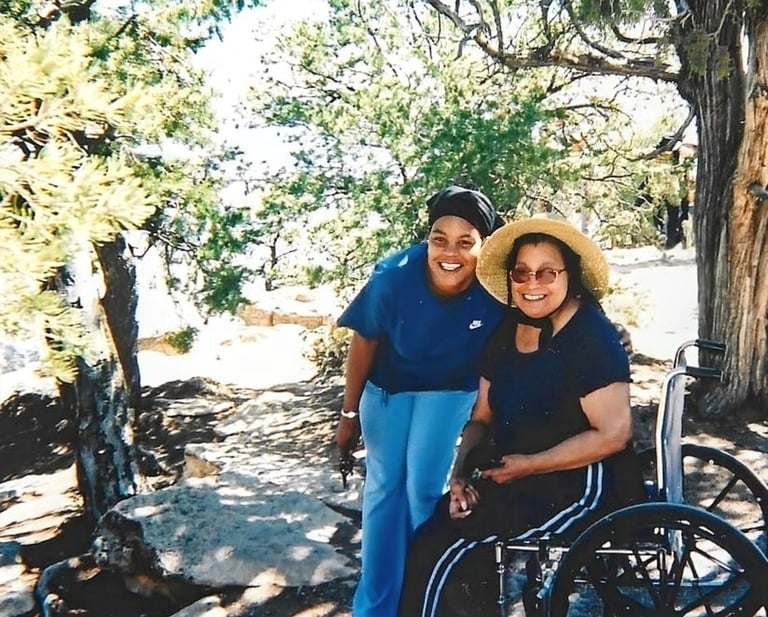
My mom and me at the Grand Canyon in Arizona


The Single, Sick & Broke Traveler
Travel stories for the brave and budget-conscious.
Contact Me!
© 2025. All rights reserved.